A paper straw seems like the simplest thing a venue can order. It is a tube. But the returns and complaints that follow a bad straw order, drinks that can’t be sipped, straws that collapse before the glass is half empty, compost bins contaminated by a straw that was never actually compostable, all trace back to a handful of avoidable decisions made at purchase. Here are the mistakes buyers make most often, and what to spec instead.
Buying by price and getting a single-ply tube
The number one driver of soggy-straw complaints is ply. A paper straw is wound from layers of food-grade paper bonded with adhesive, and the layer count is the single biggest factor in how long it survives a drink. A one- or two-ply straw is cheap to make and reliably goes limp within minutes; a well-made three- or four-ply straw holds its structure for hours in a cold beverage. When two quotes look far apart on price, ply is usually the reason, and it is the spec that gets quietly cut to hit a number. Always ask a supplier how many plies the straw uses, and treat three-ply as the practical floor for anything beyond a quick cold pour. Paying a fraction of a cent less per straw is a poor trade for a drink that becomes unusable before it’s finished. It is also worth remembering that ply interacts with bore: a wide straw carrying a thick drink is under more stress than a narrow one, so the biggest formats are exactly where skimping on layers shows up first.
Using one bore size for every drink
Straw diameter is not one-size-fits-all, and matching it to the drink is a real decision. A thin liquid moves fine through a narrow bore, but a thick shake or a bubble tea does not, and nothing frustrates a customer faster than a straw that tapioca pearls can’t pass through. Bore diameter runs from around 3 mm for a cocktail stirrer up to 13 mm for a boba straw, and each step matches a category of drink.
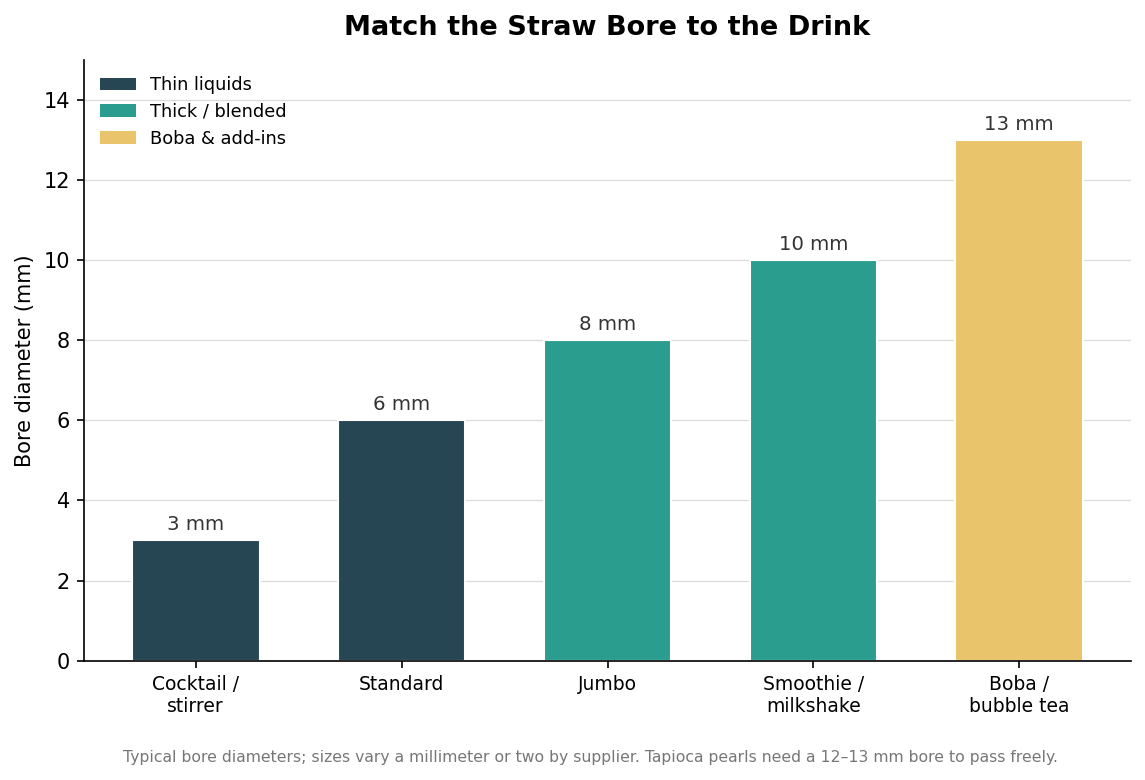
A standard 6 mm bore covers water, soda, iced tea, and iced coffee. Step up to 8 mm for pulpy juices and thin smoothies, 10 mm for thick milkshakes, and 12 to 13 mm for anything with tapioca pearls or chunky add-ins. Stocking one middle-of-the-road size for a menu that includes both espresso and boba means one of those drinks is served with the wrong straw every time. If your menu spans thin and thick, plan on at least two bores.
Getting the length wrong
A straw that vanishes into the cup or towers awkwardly above it is a small thing that customers notice. The rule of thumb is to spec a straw roughly one to two inches, about 2 to 5 cm, taller than the cup so it stands proud of the rim without tipping. In practice that means cocktail stirrers around 140 mm, standard straws near 200 mm, and taller formats past 210 mm for tumblers and boba cups.
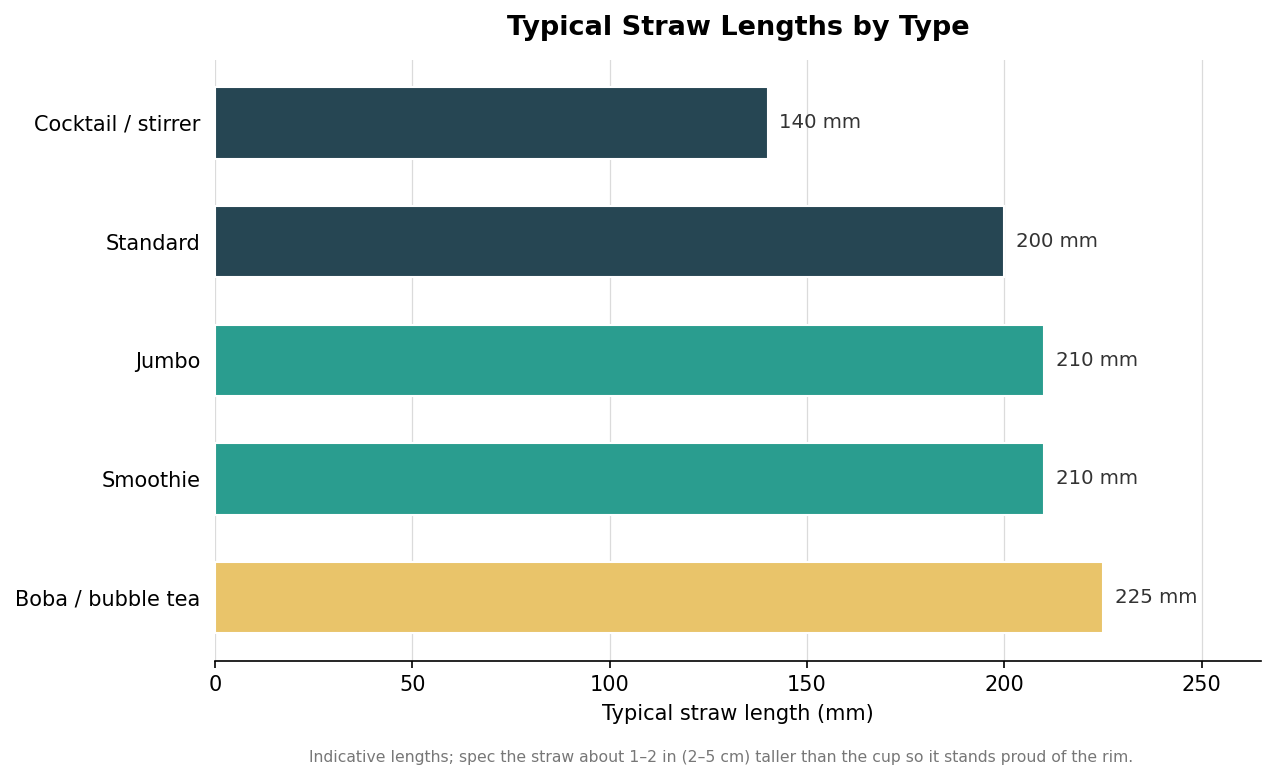
Length and diameter travel together: the tall drinks that need a bigger bore are usually the ones that need a longer straw too, which is why boba straws sit at the top of both charts. Order the length against your actual cup heights rather than a generic default, and the straw looks intentional instead of mismatched. For a venue running several cup sizes, that can mean carrying two or three lengths rather than forcing one to fit them all.
Assuming “paper” automatically means “compostable”
Paper is not a synonym for compostable, and the gap trips up well-meaning buyers. A paper straw with certain coatings, adhesives, or inks may not break down cleanly, and marketing a straw as compostable without the certification to back it is a claim that can invite scrutiny. The recognized benchmarks are ASTM D6400 in the United States and EN 13432 in Europe, and third-party BPI certification signals that a product meets the commercial-composting standard. Note the important qualifier: most of these certifications refer to industrial composting facilities that reach high temperatures, not a backyard bin, so a straw can be genuinely certified and still not compost in a home pile. If compostability matters to your brand or your customers, ask for the specific certification and the composting conditions it applies to, and keep that documentation rather than relying on the word “paper” on the box.
Overlooking wrapping, food safety, and the print
The last cluster of mistakes happens around everything that isn’t the tube itself. For hygiene, straws that will sit out or ship loose should be individually wrapped, which protects them from contamination during storage and handling; bulk-packed straws are fine behind the counter but not on an open table. Because the straw goes in the mouth, the adhesive bonding the plies and any ink used for printing should be food-grade, so confirm that with the supplier rather than assuming it. On the custom-print side, understand the difference between a simple striped or spot design and a full-wrap printed straw before you approve artwork, since they carry different setup and cost, and build in lead time: custom runs are manufactured to order and will not turn around like a stock item. Sort out wrapping, food-safe materials, print style, minimums, and timeline up front, and the order arrives as the polished, on-brand detail it was meant to be. The dimensions here are typical starting points; exact sizes and specs vary by supplier, so confirm them against samples before committing a large run.