Specifying a custom paper straw comes down to three numbers and one decision: the bore diameter, the length, the wall thickness (expressed as ply), and whether each straw is individually wrapped. Get those right and the straw fits the cup, survives the drink, and shows your print cleanly. Get them wrong and you end up with boba pearls that will not pass, straws that tower out of a short tumbler, or a two-ply tube that collapses before the glass is half empty. This walkthrough takes the four choices in the order a production artwork sheet asks for them.
Start with bore diameter, and match it to the drink
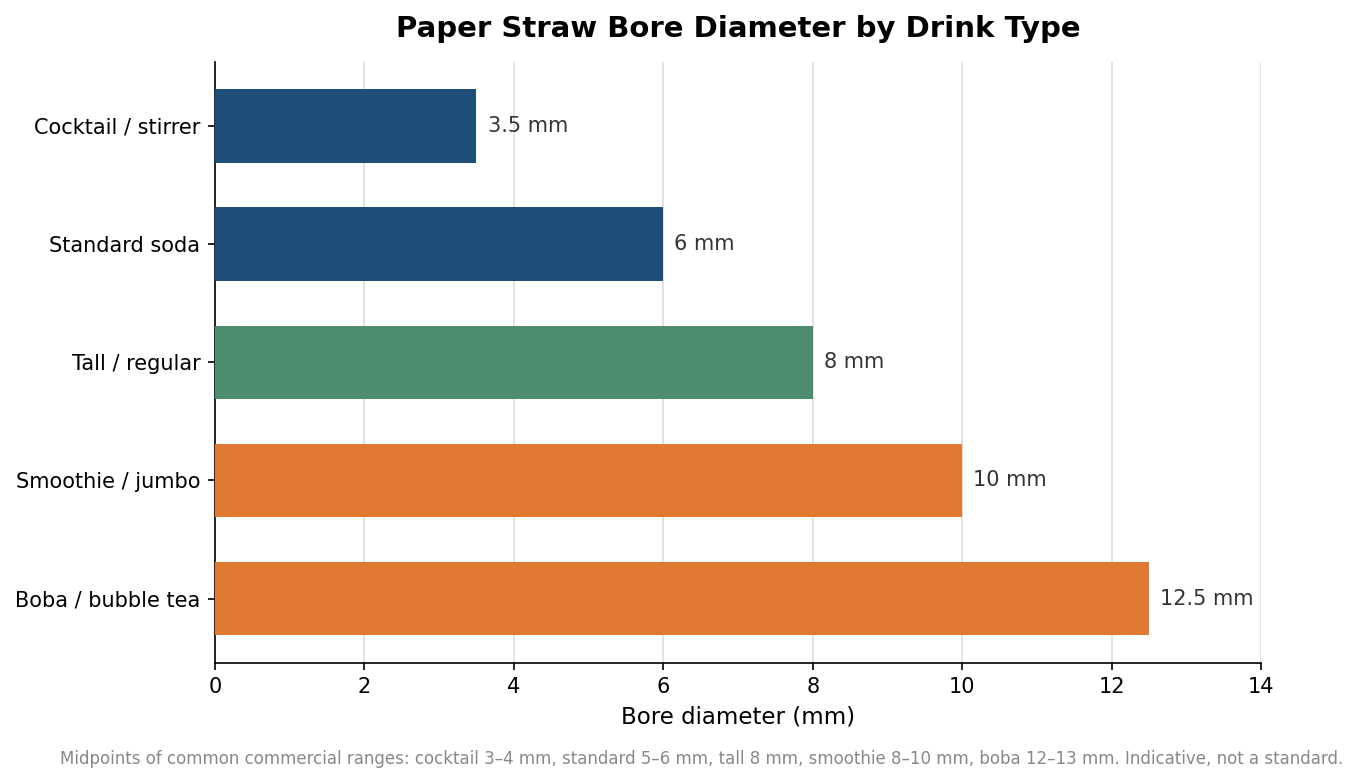
Diameter is the decision everything else hangs on. Paper straws are sold in a small set of standard bores, and each one maps to a family of drinks. A cocktail or stirrer straw runs roughly 3 to 4 mm and is meant for spirits, espresso martinis and sampler pours where you are stirring more than drinking. The everyday soda straw most people picture sits at 5 to 6 mm. Step up to about 8 mm for tall iced drinks and lemonades, 8 to 10 mm for smoothies and milkshakes that carry more body, and 12 to 13 mm for bubble tea, which is the only bore wide enough to let tapioca pearls through.
The practical rule is to size the bore to the thickest thing that has to travel up it. Thin liquids are forgiving, so a soda works fine on anything from 6 mm up. Pearls, jelly and fruit bits are not forgiving: a 10 mm straw that feels generous for a smoothie will jam on boba. When you are unsure between two sizes, order the larger of the pair for pearled or blended drinks and the smaller for clear liquids.
Set the length against your tallest cup
Length is where returns and complaints quietly come from, because a straw that disappears into the cup or sticks out by four inches reads as a mistake even when the print is perfect. Common paper straw lengths cluster around three points: a short 146 mm option, a standard 197 to 210 mm that covers most 16 to 24 oz cups, and a long 240 mm for tall tumblers, mason jars and the oversized cups used for shakes and specialty iced drinks. Not every length is offered in every bore; the shortest lengths tend to exist only in the narrow 6 mm size, while the widest 12 mm boba straws are usually made long.
Measure your actual cup, not the nominal ounce rating, and add roughly 25 to 40 mm so the straw clears the rim by a comfortable inch or so once ice pushes it up. If you run several cup sizes, spec to the tallest one rather than buying two straw lengths; a slightly long straw in a small cup looks intentional, while a short straw in a tall cup looks cheap.
Ply and wall thickness decide how long the straw lasts
Ply is the durability dial. Paper straws are wound from two, three or four layers of food-grade paper spiraled around a mandrel and glued. Two-ply straws are the thinnest and cheapest and go soft fastest, which is why most reputable custom runs are built on three plies as a baseline. Four-ply straws use an extra layer for stiffness and soak resistance and are worth the premium for thick shakes, hot drinks, or any setting where a straw sits in liquid for a long time before it is used.
Wall thickness is the physical version of the same idea, and it trades off against the usable bore. On a fixed outside diameter, a thicker wall means a narrower opening, so a heavily built 12 mm straw can end up too tight for the largest pearls. If soak life matters more than anything, ask for four-ply or a stated wall thickness rather than trusting the ply count alone, since not every supplier winds the same paper weight. Where a figure like wall thickness is quoted, treat it as indicative unless the supplier commits to it in writing, because it varies with the paper stock.
Wrapping, printing and the minimums that come with them
Individually paper-wrapped straws cost more and are worth it in the right venue. A paper sleeve keeps the straw sanitary on a self-serve counter and gives you a second printable surface, but it adds material and a wrapping pass, so it raises both unit price and lead time. Bulk-boxed straws are cheaper and fine behind a bar where staff hand them over. For print itself, paper straws take flexographic or similar food-safe inks well; simple logos, stripes and one or two spot colors reproduce far more reliably than fine gradients on a curved, matte surface.
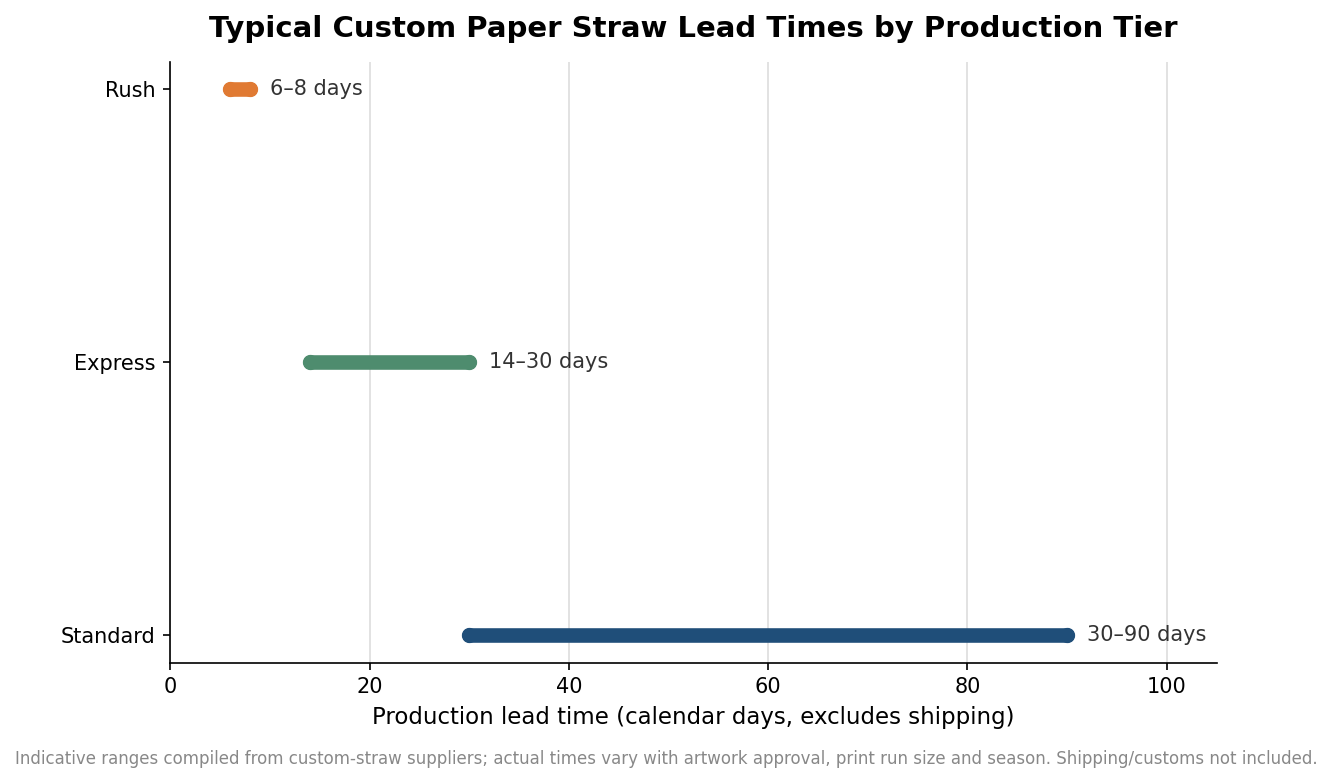
Custom printing carries real minimums because the press has to be set up per design. A common floor for custom-printed paper straws is around 5,000 units, and pricing improves sharply with volume. Lead times depend on how you buy: a rush tier can turn around in roughly 6 to 8 days, an express path in two to four weeks, and standard overseas production commonly runs one to three months once artwork is approved. Those windows exclude shipping and customs, which can add materially on ocean freight.
A quick way to write the spec
Put the four numbers on one line and you have a brief a supplier can quote against: bore diameter matched to the drink, length set to your tallest cup plus clearance, three-ply as a floor with four-ply for demanding drinks, and wrapped or bulk depending on where the straw is handed over. Add your color count and your quantity, and note whether you need a compostability claim, because certified-compostable stock is a specific material choice rather than a finish you add later. With those decided, the artwork stage is mostly about keeping the design simple enough to print sharply on a narrow, matte tube.