“Compostable” hides a lot of important differences. A paper straw, a PLA straw, and a PHA straw can all sit in the same “eco” bin on a supplier’s site, yet they behave nothing alike in a hot latte, in a home compost pile, or in the eyes of a single-use plastic law. If you are choosing straws for a real beverage program, the material is the decision that drives performance, disposal, and even whether the straw is legal to hand out. Here is what each one actually does.
Paper: cheapest and widely compostable, but time-limited in the cup
Paper is the low-cost, broadly available default, and its main enemy is time in liquid. A thin single-ply straw can turn soft within minutes, while a well-made three-ply straw with a tight wind stays firm for hours—which is exactly why ply and wall thickness matter so much when you spec paper. Because it is cellulose, paper handles heat without melting, so a hot drink is not the problem; saturation is. The trade-offs beyond sogginess are a faint papery taste in delicate drinks and the fact that the print inks and seam adhesive ride along into whatever you do with it afterward.
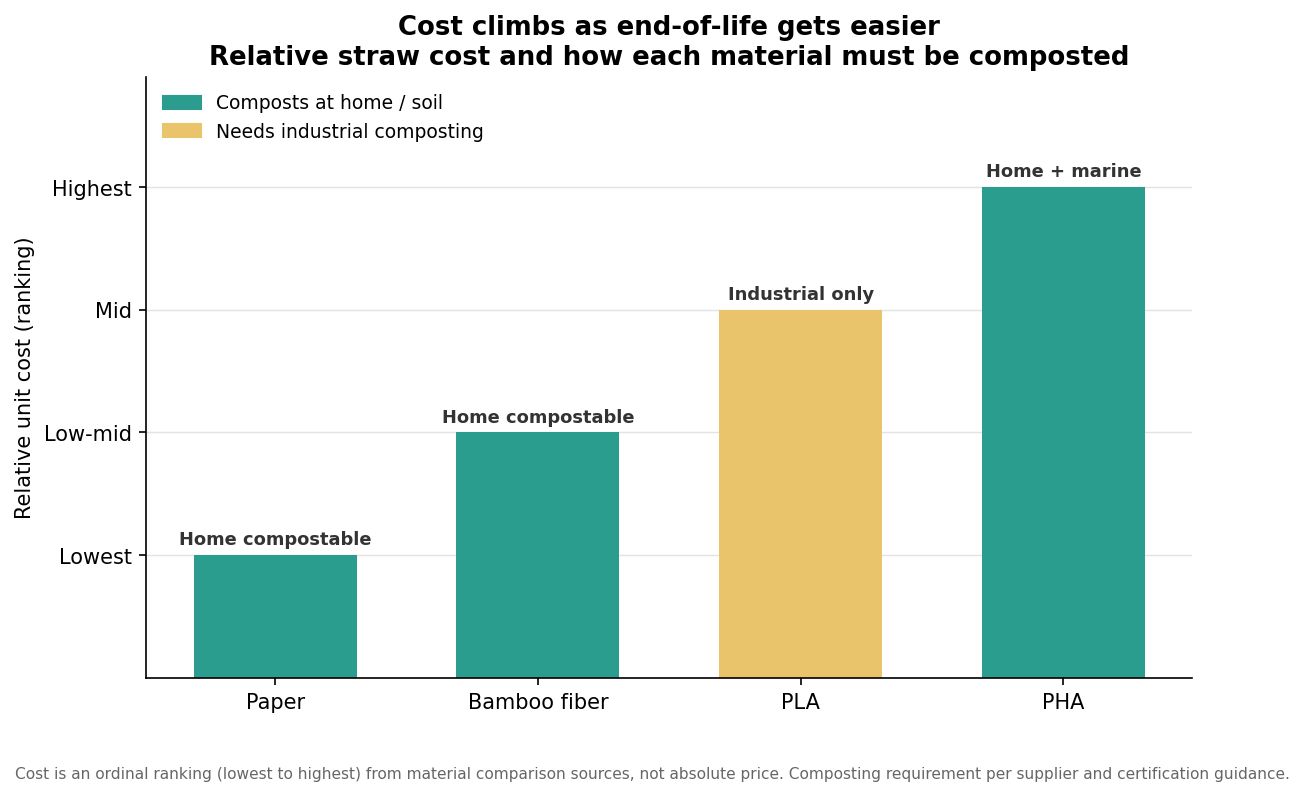
On disposal, paper is the easy case. It is generally home compostable and breaks down in ordinary conditions without an industrial facility, and it carries the lowest unit cost of the common options thanks to a deep supplier base. For high-volume, cold-and-quick service—water, soft drinks, iced tea—paper is usually the sensible pick, provided you buy enough ply for the drink.
PLA: looks like plastic, behaves like plastic in a hot drink
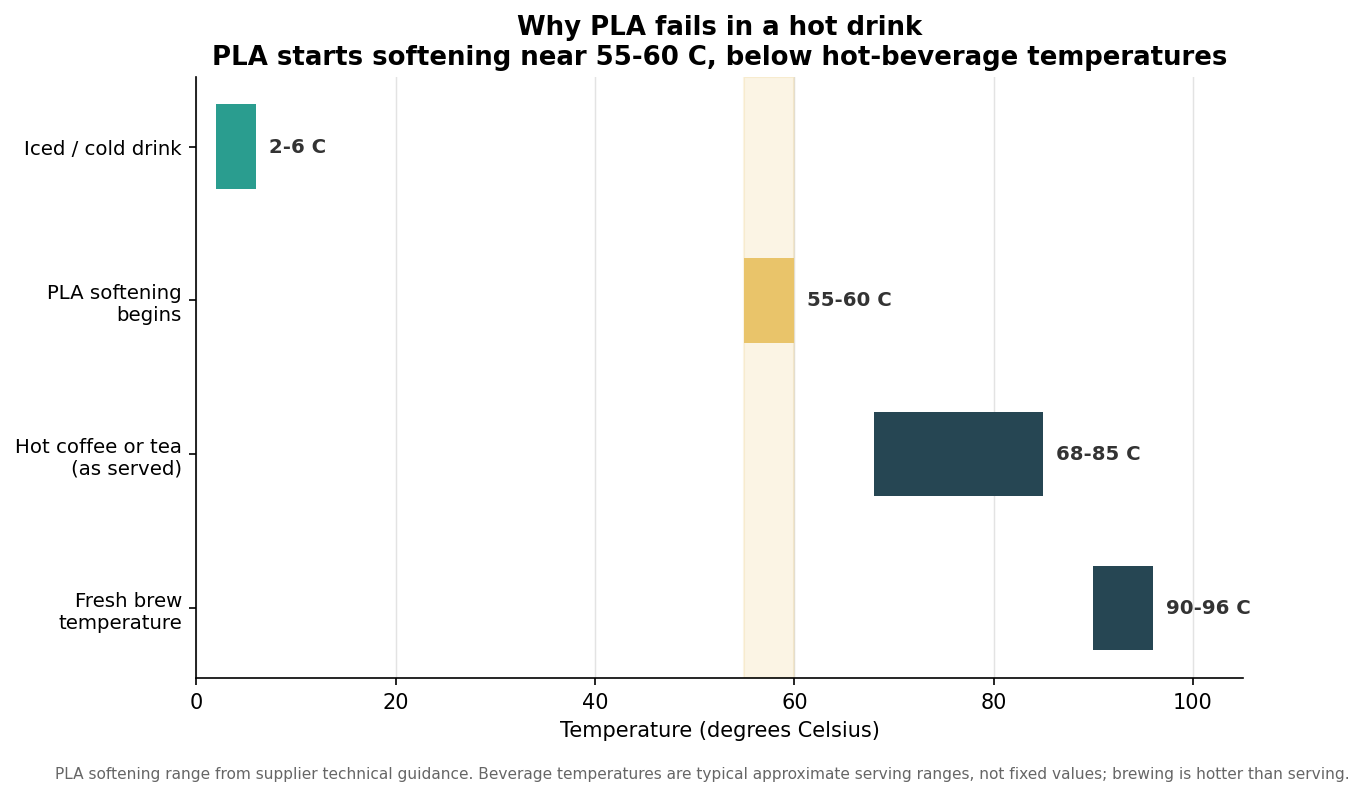
PLA is a corn-derived bioplastic that feels like a conventional plastic straw, which is both its appeal and its problem. It stays clear and firm in cold drinks and does not go soggy, so it looks like an upgrade over paper. The catch is heat: PLA begins to soften at roughly 55 to 60 degrees Celsius (about 140 Fahrenheit), well below the temperature of fresh coffee or tea, so it is not suitable for hot beverages and can deform in the cup.
Disposal is the bigger surprise for buyers. PLA is not home compostable. It needs industrial composting—sustained heat around 60 degrees Celsius for several days—and in much of the United States those facilities are not available to most businesses, so a PLA straw that misses an industrial composter behaves like ordinary plastic in a landfill. It sits at a mid-level cost, above paper. PLA earns its place in cold-drink programs where it will actually reach an industrial composter, and it disappoints where either condition fails.
PHA and bamboo fiber: the premium end that composts at home
PHA is the material that comes closest to solving the disposal problem, at a price. It is home compostable and, unusually, biodegrades in soil and marine environments rather than needing an industrial facility, which is why it is often described as the ocean-safe option. It holds up better than paper in liquid and avoids the papery taste. The reason it is not everywhere is cost: PHA carries the highest unit price of the mainstream choices, so it tends to appear in premium or sustainability-forward brands rather than high-volume budget service.
Bamboo fiber sits nearby as a firm, low-to-mid-cost option that stays rigid in both iced and hot drinks and adds no taste, and quality versions carry home-compostable certification. Between them, PHA and bamboo fiber cover the cases where paper is too soft, PLA is too heat-sensitive or too hard to compost, and the brand is willing to pay for it.
The regulatory catch: “compostable plastic” can still be banned
The most expensive mistake is assuming that a bioplastic is automatically exempt from a straw ban. It often is not. The European Union’s Single-Use Plastics Directive treats compostable plastics the same as conventional ones, and UK guidance is explicit that the rules apply to materials like PLA. In other words, a straw can be genuinely compostable and still be an illegal single-use plastic in the jurisdiction where you plan to serve it. Fiber-based straws—paper and bamboo fiber—generally sit outside those plastic definitions, while PLA and other bioplastics can fall squarely inside them.
This is why material choice and compliance are the same conversation. Before standardizing on any bioplastic, check how your specific state, city, or country defines “plastic,” and whether a compostability certification such as ASTM D6400 or EN 13432 actually changes that definition where you operate. A certification proves how a straw breaks down; it does not automatically override a ban written around the material.
Choosing a material for your program
Work from the drinks and the disposal reality, not the marketing word on the box. If you serve mostly cold drinks at volume and want the lowest cost and the simplest composting story, paper in the right ply is hard to beat. If you want a clear, plastic-like straw for cold drinks and you have genuine access to industrial composting, PLA fits—just keep it away from hot service and be honest that it needs the right facility. If you want home-compostable or ocean-safe credentials and will pay for them, PHA or bamboo fiber deliver, with bamboo fiber adding real heat tolerance.
Then cross-check the law where you will actually use the straws, because a material that is perfect on performance can still be off the table under a local plastics definition. Match the straw to the drink temperature, the disposal infrastructure your customers really have, and the regulation you have to meet, and the “compostable” label on the case will finally mean what your buyers think it means.